




The software charge is the easiest part of an AI-video pilot to see. It appears on a pricing page, an invoice or a credit balance.
The less visible cost begins when the first result arrives.
A marketing manager has to decide whether the scene represents the brief. A brand reviewer checks the people, setting and implied claims. Someone requests another version. An editor prepares the accepted draft for a real channel. A final approver asks which file is current and what changed between versions.
None of that work disappears because the generation itself was quick or inexpensive. For a business deciding whether to scale AI video, the useful question is not “How much does one clip cost?” It is “What does it take to produce one approved asset for this specific job?”
Five Costs Belong in the Pilot Ledger
A small pilot needs a fuller ledger than subscription plus credits.
The first cost is brief preparation. The team must define the audience, message, source material, visual boundary and prohibited details. A weak brief moves those decisions into the generator, where they become harder to control.
The second is generation. Record the model, mode, settings, number of runs and credits consumed. Failed outputs remain part of the cost even if they never reach an approver.
The third is review. Someone must inspect people, products, text, locations, continuity and any visual claim implied by the scene. A five-second clip can still contain several decisions that the brand never made.
The fourth is revision. This may involve a new prompt, another source image, a different generation or conventional editing. “One more version” is not free merely because there is enough credit balance.
The fifth is production handoff. The selected draft may still need verified text, captions, sound, branding, a different aspect ratio, a poster frame and channel approval.
A pilot that records only the second cost is measuring the tool, not the business process.
A Two-Prompt Test Shows Where Work Appears
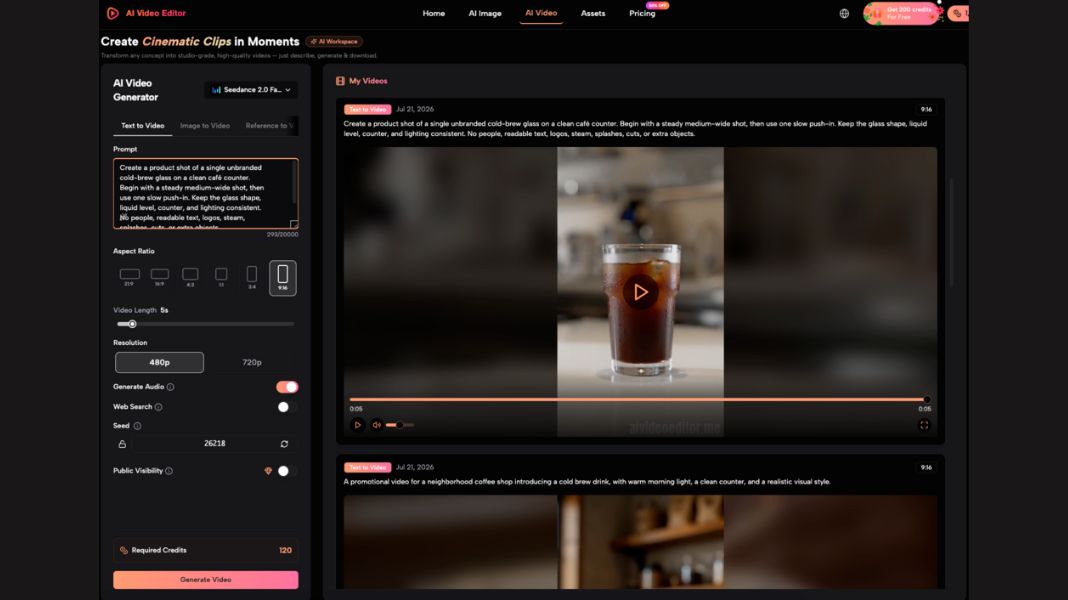
In a paired test for a fictional neighbourhood coffee shop, both outputs used Text to Video mode in an AI Video Editor, with Seedance 2.0 Fast, a 9:16 setting, a five-second duration and the interface’s 480p option. The exact credits and generation time were not recorded, so the test cannot support a cost-per-video claim.
The first prompt was broad:
A promotional video for a neighborhood coffee shop introducing a cold brew drink, with warm morning light, a clean counter, and a realistic visual style.
The result interpreted “promotional video” as a small production sequence. It showed hands working with a pour-over setup, coffee beans being added, coffee poured over ice and a hand presenting the finished glass. The warm setting and cold-brew subject matched the brief. The generator also chose the people, props, actions, shot changes and preparation story.
Those choices are not automatically defects. A cafe may like the human preparation sequence. Another brand may reject it because the process does not match its recipe, the hands require approval, or the campaign called for a simple product shot.
The second prompt described that narrower requirement:
Create a product shot of a single unbranded cold-brew glass on a clean cafe counter. Begin with a steady medium-wide shot, then use one slow push-in. Keep the glass shape, liquid level, counter, and lighting consistent. No people, readable text, logos, steam, splashes, cuts, or extra objects.
The second output kept one glass centred on the counter and moved gradually closer. Across samples taken throughout the clip, no person, readable text, logo, steam, splash, cut or extra foreground object appeared. The glass, liquid level, counter and background remained visually stable, although small ice details still deserved review as the camera moved closer.
The useful finding is not that a longer prompt always produces a better video. It is that the two prompts created different approval tasks. The broad version required the team to evaluate an invented narrative. The constrained version required a more specific brief and another generation, but produced a narrower object for review in this test.
That trade-off belongs in the ledger.
 Budget the Approval Path Before Scaling
Before a marketing team decides to Edit Videos Online as part of a recurring workflow, it should identify the people between draft and publication.
A simple responsibility map can prevent hidden queues:
- marketing owner approves the message and channel;
- brand owner approves visual identity and prohibited elements;
- subject specialist checks factual implications;
- editor prepares the channel-ready asset;
- final approver accepts or rejects the version.
Not every five-second social concept needs five meetings. The point is to know which decisions exist and who owns them. If one person covers several roles, record that too. Small teams are not exempt from approval work; they simply concentrate it.
Set a revision rule. For example, allow two planned generations and one reserve run for a technical failure. If neither planned result meets the acceptance criteria, stop and revisit the brief instead of generating variations indefinitely.
The stop rule protects both credits and attention. It also prevents a pilot from being judged only by the best-looking output found after an unknown number of attempts.
Report a Business Decision
At the end of the pilot, management should receive more than a folder of clips. The report should answer:
- Which content job was tested?
- How many planned and unplanned generations were required?
- Which review issues appeared?
- What manual production work remained?
- Which claims or formats were excluded?
- Should the workflow scale, remain limited to concepts, or stop?
The paired coffee test supports a cautious conclusion: adding constraints changed the review burden in one documented case. It does not prove a universal productivity gain, a reliable cost reduction or better performance than another platform.
That restraint is important. The purpose of a pilot is not to justify a purchase already made. It is to expose the full process early enough for a business to decide whether the workflow is worth repeating.